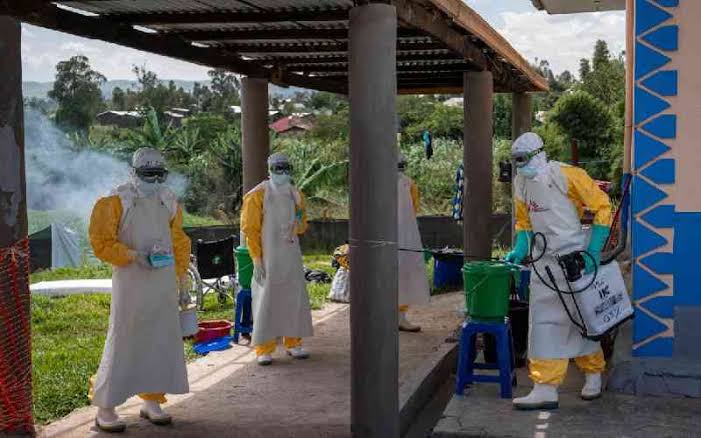
A rapidly expanding Ebola outbreak in Central Africa could spiral past 20,000 infections within months if containment falters, according to new projections from the U.S. Centres for Disease Control and Prevention. The warning comes as health workers confront a rare virus strain, fragile health systems and active conflict zones that are hampering the response.
CDC modelling outlines a wide range of possible trajectories, from roughly 10,000 infections to well beyond 20,000. In the worst scenarios, the crisis could begin to resemble the catastrophic West African epidemic that sickened tens of thousands and overwhelmed regional health services.
“Without strong public health interventions, an outbreak of that scale is possible,” said Dr. Satish Pillai, who leads the CDC’s Ebola response. The agency’s simulations show that the single most important factor is how quickly infected people can be identified and isolated before they pass the virus to others.
Under a scenario where only about one in five patients is successfully isolated, the models suggest more than 20,000 infections and thousands of deaths could occur within three months. If health workers manage to isolate 50 to 70 percent of cases, the total caseload could be cut roughly in half.
Experts caution that these figures are scenarios, not precise forecasts. Jennifer Nuzzo, director of Brown University’s Pandemic Centre, said the projections reinforce long-standing fears that the epidemic could accelerate, but stressed that limited data and fast-changing conditions make exact predictions impossible.
The outbreak is driven by the Bundibugyo strain of Ebola, a relatively rare variant for which there is no licensed vaccine or targeted antiviral treatment. Ebola spreads through direct contact with bodily fluids such as blood, vomit and semen, and typically causes high fever, vomiting, diarrhoea and internal bleeding. The disease is often fatal without intensive supportive care.
Regional health authorities have confirmed around 400 cases and more than 60 deaths, though specialists believe the true toll is higher because many infections are never formally recorded. Surveillance teams struggle to reach remote communities, and some families hide sick relatives for fear of stigma or mistrust of authorities.
Conflict is compounding the danger. Fighting between government forces and the M23 rebel group, as well as attacks by the Allied Democratic Forces, has displaced civilians, shuttered clinics and forced aid workers to suspend operations in some areas. These disruptions make it harder to trace contacts, transport samples and safely bury the dead.
The World Health Organization has designated the crisis a global health emergency, triggering increased international support. Teams from African and international agencies are working to expand laboratory capacity, train local health workers, improve infection control in clinics and engage community leaders to counter rumours and resistance.
Officials acknowledge that earlier Ebola models have sometimes overestimated final case numbers, but argue that planning for worst-case scenarios is essential. The latest projections, they say, are less a prediction than a stark reminder: if isolation, surveillance and community cooperation falter, the outbreak could become one of the largest Ebola emergencies on record.





.jpeg?alt=media&token=4fe71d41-06e4-4a93-bd6d-bb499de503a6)